The 2-Layer Water Balance Method
The 2-Layer Water Balance Method is an alternative to the more complex unsaturated flow process coupled to the Kristensen and Jensen module for describing evapotranspiration. The 2-Layer Water Balance Method is based on a formulation presented in Yan and Smith (1994). The main purpose of the module is to calculate actual evapotranspiration and the amount of water that recharges the saturated zone.
The module is particularly useful for areas with a shallow ground water table, such as swamps or wetlands areas, where the actual evapotranspiration rate is close to the reference rate. In areas with deeper and drier unsaturated zones, the model does not realistically represent the flow dynamics in the unsaturated zone. The model only considers average conditions and does not account for the relation between unsaturated hydraulic conductivity and soil moisture content and, thereby, the ability of the soil to transport water to the roots. The model simply assumes that if sufficient water is available in the root zone, the water will be available for evapotranspiration. However, it is usually possible to “calibrate” the input parameters so that the model performs reasonably well under most conditions.
The 2-Layer Water Balance Method includes the processes of interception, ponding, and evapotranspiration, while considering the entire unsaturated zone to consist of two ‘layers’ representing average conditions in the unsaturated zone. The vegetation is described in terms of leaf area index (LAI) and root depth. The soil properties include a constant infiltration capacity and the soil moisture contents at the wilting point, field capacity and saturation.
The output is an estimate of the actual evapotranspiration and the ground water recharge.
Leaf Area Index (LAI)
The area of leaves above a unit area of the ground surface is defined by the leaf area index, LAI. Generalised time varying functions of the LAI for most crops and types of vegetation are available in the literature. In MIKE SHE, you must specify the temporal variation of the LAI for each vegetation type during the growing seasons to be simulated. Different climatic conditions from year to year may require a shift of the LAI curves in time but will generally not change the shape of the curve. Typically, the LAI varies between 0 and 7.
Root Depth
The root depth is defined as the maximum depth of active roots in the root zone.
1. Explicit ET calculation
The calculation of ET is explicit and the removal of ET from the various storages in MIKE SHE happens only at specific times in the calculation process, as described in the following:
- Evaporation and sublimation is removed from snow (if present),
- Bypass infiltration is calculated (if included),
- Flow from paved areas is calculated (if included),
- Infiltration to UZ and recharge to SZ calculated,
- Evaporation from the canopy is calculated,
- Evaporation from Ponded water is calculated,
- Transpiration from the unsaturated zone is calculated, and then
- Transpiration from the saturated zone is calculated.
- the UZ/SZ water balance is checked and the SZ groundwater table is corrected if necessary.
However, if the Extra Parameter option Transpiration during ponding is specified, then the order above is changed, where
- Transpiration from the unsaturated zone is calculated,
- Transpiration from the saturated zone is calculated, and then
- Evaporation from Ponded water is calculated.
2. Soil Moisture
ET Extinction depth - If the capillary fringe reaches the bottom of the root zone, then water removed from the root zone by ET will be replaced by water drawn up by capillary action. The ET extinction depth is then the maximum depth where ET can be removed from the saturated zone by the roots - that is the root depth + the thickness of the capillary fringe.
In the 2-Layer Water Balance Method the unsaturated zone can consist of one or two layers.
- The upper layer extends from the ground surface to the ET extinction depth. If the water table is at the ground surface then the thickness of the upper layer is zero.
- If the water table is below the ET extinction depth, then a second layer is added that extends from the bottom of first layer to the water table. If the water table is above the ET extinction depth, the thickness of the lower layer is zero.
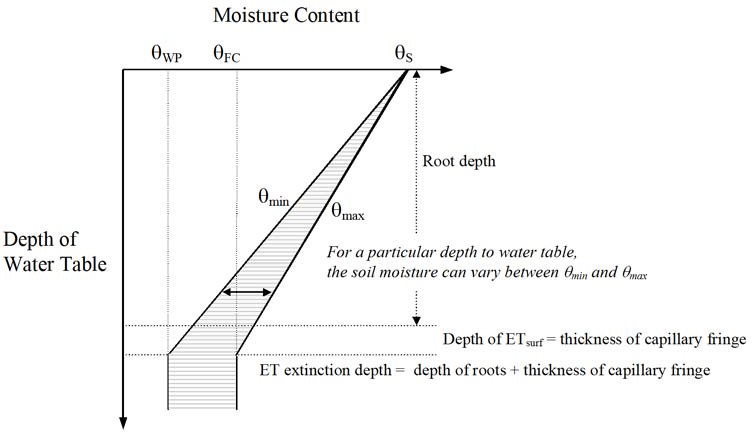
Figure 21.9: Allowable range for soil moisture in the upper ET layer as a function of the depth to the water table.
a. Water table at ground surface
If the water table is at the ground surface then the moisture content equals the saturated moisture content, \(\theta_s\).
b. Water table above ET extinction depth
If the water table is above the ET extinction depth, then the average water content in the upper UZ layer will vary between a minimum, \(\theta_{min}\), and a maximum, \(\theta_{max}\) (see Figure 21.9). \(\theta_{max}\) is the water content that would be present if no ET occurred. \(\theta_{min}\) is the minimum water content that can exist in the upper ET layer when ET is active. Both \(\theta_{min}\) and \(\theta_{max}\) decrease linearly with the depth to the water table. In other words, the average water content of the entire column decreases as the water table drops because the upper part of the column is draining to the field capacity. When the water table is at the extinction depth, the average water content of will be field capacity if there is no ET.
When ET is removed, the water content will decrease from \(\theta_{max}\). The water content will increase again up to \(\theta_{max}\) when infiltration occurs. Thus, the total storage deficit of the top layer of the unsaturated zone, \(D_{uz}\) is
Equation 21.12:
\(D_{uz} = (\theta_{max} - \theta_{act}) \cdot Z_{wt}\)
and the total storage available for ET, \(S_{uz}\) is
Equation 21.13:
\(S_{uz} = (\theta_{act} - \theta_{min}) \cdot Z_{wt}\)
where \(\theta_{act}\) is the actual water content at the end of the previous time step and \(Z_{wt}\) is the thickness of the upper UZ layer.
Vertical infiltration to the lower UZ layer or to the saturated zone occurs when the water content is equal to \(\theta_{max}\).
c. Water table below ET extinction depth
If the water table is below the ET extinction depth, then a lower UZ layer is added. The moisture content of the lower UZ layer is generally equal to the field capacity because ET is not removed from the lower UZ layer. However, the water content of the lower UZ layer can range between the field capacity and the wilting point. If the water content is equal to field capacity then an infiltration from the upper UZ layer will be added to the top layer of the SZ model as groundwater recharge.
d. Changing layer thicknesses
The thickness of the upper and lower UZ layers changes whenever the root depth or the water table changes. Thus, even if there is no ET or infiltration, a changing layer thickness will change the average water content of the layer because the current water content will be redisributed within a smaller or larger volume.
If the water content in the upper UZ layer is currently at or near \(\theta_{min}\), a decrease in the root depth (e.g. crop harvest) can lead to a redistributed water content that is less than the new \(\theta_{min}\). In this case, if the water table is above the extinction depth, water will be transfered from the SZ model to the upper UZ layer to bring the water content back up to \(\theta_{min}\). If the water table is below the extinction depth, the water content will simply remain below \(\theta_{min}\) until infiltration increases the water content, or until the water table rises to the new extinction depth.
If the water table is above the extinction depth and falls, then the restributed water content of the upper UZ layer will be calculated based on the added layer thickness times the saturated water content.
A redistributed water content above \(\theta_{max}\) in the upper UZ layer will result in discharge to either the lower UZ layer or the upper SZ layer depending on the location of the water table.
The water content of the lower UZ layer is generally at field capacity because ET is not removed from the lower UZ layer. However, changing layer thicknesses will cause a redistribution of water content which can result in a water content below field capacity. For example, if the upper UZ layer water content is at or near \(\theta_{min}\) and the root depth suddenly decrease (e.g. the root depth could suddenly become zero due to a crop harvest) then the average water content of the lower UZ layer will drop well below field capacity.
e. Canopy Interception
Interception is defined as the process whereby precipitation is retained on the leaves, branches, and stems of vegetation. This intercepted water evaporates directly without adding to the moisture storage in the soil.
The interception process is modelled as an interception storage, which must be filled before stem flow to the ground surface takes place. The maximum amount of interception storage, Sint max, depends on the vegetation type and its stage of development, which is characterised by the leaf area index, LAI. Thus,
Equation 21.14
\(S_{intmax} = C_{int} \cdot LAI\)
where \(C_{int}\) is the interception storage capacity that defines the maximum amount of interception storage for the vegetation. A typical value is about 0.05 mm but a more exact value may be determined through calibration.
The interception storage, \(S_{int}\), is accumulated over time. So, if the amount of precipitation in the time step, plus the current amount of storage, exceeds \(S_{intmax}\), then the interception storage will equal \(S_{intmax}\) and any excess will be added ponded water on the ground surface. If \(S_{intmax}\) is not exceeded, then the canopy will capture all of the available precipitation in the time step.
If the LAI decreases between time steps (e.g. after a crop harvest), \(S_{intmax}\) will decrease and any excess interception storage will be added to the ponded water on the ground surface.
3. Infiltration
At the beginning of each time step, sprinkler irrigation and snowmelt is added to the available precipitation. This available precipitation first fills the interception storage. If Sint max is exceeded, the excess water is added to the current amount of ponded water on the ground surface.
Then direct bypass infiltration to SZ is calculated and the depth of ponded water is updated.
After the calculation of the bypass infiltration, the depth of ponded water is updated for drainage to paved areas (see ).
After the removal of bypass flow and drainage to paved areas, the infiltration to the upper UZ layer is calculated, limited by
-
the amount of available water for infiltration - the depth of ponded water, dOL,
-
the rate of infiltration, and
- the estimated amount of water than would raise the water table to the ground surface in the current time step.
The rate of infiltration is adjusted for two special conditions. In the first case, the infiltration can be higher when the soil is very dry (see Saturated Zone). In the second case, the infiltration rate will be reduced if you have specified an Surface-Subsurface Leakage Coefficient that is lower than the specified leakage coefficient in the 2-Layer UZ soil properties dialogue.
The amount of infiltration can also be limited when the amount of ponded water is below a specified threshold, since the 2-Layer water balance method does not include evaporation from the soil surface. Thus, even a small amount of water on the ground surface will infiltrate. If you define a depth of overland water that must be exceeded before infiltration will occur, small amounts of precipitation will not infiltrate, but rather evaporate instead. The calculated infiltration is simply reduced if the remaining overland water depth will be smaller than the specified threshold value. See Threshold depth for infiltration (2-Layer UZ).
The actual infiltration to the upper UZ layer is then calculated - subject to the limits described above. Any surplus water above \(\theta_{max}\) is added to the lower UZ layer. In the lower UZ layer, any surplus water above \(\theta_{FC}\) is added to the upper SZ layer. Finally, ponding depth and the water contents in the upper and lower UZ layers are recalculated and updated.
4. Evapotranspiration
MIKE SHE uses the Crop Reference ET rate for all calculations of ET. The Crop Reference ET rate is
Equation 21.15
\(ET_{rate} = ET_{crop} = ET_{ref} \cdot k_c\)
where \(ET_{ref}\) is the Reference Evapotranspiration and \(k_c\) is the Crop Coefficient specified in the Vegetation Development Table that adjusts the Reference ET rate for different vegetation types. The maximum amount of ET that can be removed in one time step is
Equation 21.16
\(ET_{max} = ET_{rate} \cdot \Delta t\)
\(ET_{max}\) is satisfied in the following order:
- ET is first removed from snow storage.
- If the snow storage cannot satisfy \(ET_{max}\), water is evaporated from the interception storage.
- If the interception storage cannot satisfy \(ET_{max}\), water is evaporated from the ponded water until the ponded water is exhausted.
- If \(ET_{max}\) has not yet been satisfied, water is removed from the unsaturated zone until \(ET_{max}\) is satisfied or the water content of the upper UZ layer is reduced to \(\theta_{min}\).
- If \(ET_{max}\) has still not yet been satisfied, water is extracted from the saturated zone if the water table is above the ET extinction depth.
However, if Transpiration during ponding is allowed, then the order of the last three calculations above are changed and ET is removed from the ponded water after being removed from the UZ and SZ.
a. ET from Snow
ET from snow is a sum of the ET from wet snow and and dry snow storages.
Equation 21.17
\(ET_{snow} = ET_{wetsnow} + T_{drysnow}\)
ET will be first removed from the wet snow storage, if it exists,
\(ET_{wetsnow} = ET_{ref} \cdot \Delta t\)
where \(ET_{ref}\) is the Reference Evapotranspiration before being reduce by the Crop Coefficient, \(k_c\), that is specified in the Vegetation Development Table.
However, if there is insufficient wet snow storage, then ET will be removed from dry snow as sublimation using
Equation 21.18
\(ET_{drysnow} = ET_{ref} \cdot S_f \cdot \Delta t\)
where \(S_f\) is the sublimation reduction factor found on the Snow Melt dialog, which reduces the amount of ET that can be removed from dry snow due to the extra energy required to sublimate snow.
If there is not enough snow storage then \(ET_{snow}\) will reduce the snow storage to zero.
b. ET from the Canopy
After the ET is removed from any available snow storage, ET is removed from the canopy storage until the canopy storage is exhausted or \(ET_{max}\) is satisfied using
Equation 21.19
\(ET_{canopy} = ET_{rate} \cdot S_f \cdot \Delta t\)
If there is not enough canopy storage then \(ET_{canopy}\) will reduce the canopy storage to zero.
c. ET from Ponded Water
ET is removed from the ponded storage until \(ET_{max}\) is satisfied or the ponded storage is exhausted. Thus,
Equation 21.20
\(ET_{ponded} = ET_{rate} \cdot S_f \cdot \Delta t\)
If there is not enough ponded storage then \(ET_{ponded}\) will reduce the ponded storage to zero.
d. ET from the Unsaturated Zone
ET is only removed from the upper UZ layer. However, as the water content of the root zone decreases, plants will find it harder to remove the water.
Finally, when the wilting point is reached ET will stop. However, the reduction in ET does not occur immediately. Plants will remove ET from the root zone at the maximum rate until a plant specific water content is reached, at which point the rate of ET removal will be restricted. In the 2-Layer Water Balance method this phenomena is accounted for by a plant specific deficit fraction. ET will be removed at the maximum rate until this deficit fraction is reached, then linearily reduced to zero as the water content falls to the wilting point.
Thus, the ETrate is reduced by
Equation 21.21
\(F_{ETUZ} = \frac{min(\theta_{act},\theta_p) - \theta_{min}}{\theta_p - \theta_{min}}\)
where \(\theta_p\) is water content when ET begins to be restricted given by
Equation 21.22
\(\theta_p = \theta_{min} + F_p \cdot (\theta_{max} - \theta_{min})\)
\(\theta_{act}\) is the current water content in the upper layer, \(\theta_{min}\) and \(\theta_{max}\) are the minimum and maximum water contents in Figure 21.9 and \(F_p\) is the user-specified, plant-specific deficit fraction when ET begins to be restricted by a lack of soil water. From Equations (21.21) and (21.22) \(\theta_p\) is variable if the ET extinction depth is above the bottom of the root zone. If the ET extinction depth is below the root zone, then \(\theta_p\) represents the minimum water content for full ET. Crop specific values for \(\theta_p\) can be found in the literature or from the FAO.
- A typical value for this \(F_p\) is 0.5. This means that the ET will be removed from the UZ at the full rate until the deficit reaches half the maximum deficit.
- A \(F_p\) of 1 means that ET will start being reduced as soon as the water content falls below \(\theta_{max}\).
- A \(F_p\) of 0 means that ET will not be reduced and ET will be removed at the maximum rate until the wilting point is reached.
ET is removed from the upper UZ layer until ETmax is satisfied or the average water content is reduced to the wilting point. Thus,
Equation 21.23
\(ET_{UZ} = ET_{rate} \cdot F_{ETUZ} \cdot \Delta t\)
However, if Transpiration during ponding is allowed, then FETUZ is multiplied by the anaerobic tolerance factor to account for the decreased capacity for ET when there is ponded water on the ground surface. Also, the maximum remaining amount of ET that can be removed is also reduced by the anaerobic tolerance factor, Fantol. That is,
Equation 21.24
\(ET_{left} = (ET_{max} – ET_{snow} – ET_{canopy}) \cdot F_{antol}\)
e. ET from the Saturated Zone
If the water table is above the extinction depth, then ET is removed from SZ until ETmax is satisfied using
Equation 21.25
\(ET_{SZ} = ET_{rate} \cdot F_{ETSZ} \cdot \Delta t\)
where \(F_{ETSZ}\) is 1.0 when the water table is in the root zone and decreases linearly from 1.0 to zero when the water table is below the root zone, but above the extinction depth.
If the water table is below the extinction depth, then \(F_{ETSZ}\) is zero, and no ET is removed from the saturated zone.
In the case where Transpiration during ponding is allowed, then, \(F_{ETSZ}\) is multiplied by the anaerobic tolerance factor to account for the decreased capacity for ET when there is ponded water on the ground surface. Also, the maximum remaining amount of ET that can be removed is also reduced by the anaerobic tolerance factor, Fantol. That is,
Equation 21.26
\(ET_{left} = (ET_{max} – ET_{snow} – ET_{canopy} – ET_{UZ}) \cdot F_{antol}\)
f. Actual ET
Finally, the actual evapotranspiration is the sum of the above contributions
Equation 21.27
\(ET_{actual} = ET_{snow} + ET_{canopy} + ET_{ponded} + ET_{UZ} + ET_{SZ}\)
remembering that\(ET_{actual}\) cannot be greater than \(ET_{max}\) and that the ET is calculated in a specific order until \(ET_{max}\) is reached.
5. Coupling to the Saturated Zone
At the end of the ET calculation step, the change in storage in the upper SZ cell is compared to the change in storage in upper and lower UZ layers, plus the amount of water removed by ET and any infiltration and recharge to SZ. If this water balance exceeds the limit specified in the UZ Computational Control Parameters dialog, then a depth correction is calculated for the water table and the water table elevation is adjusted, while ensuring that the exchange between UZ and SZ does not exceed the UZ infiltration rate.